
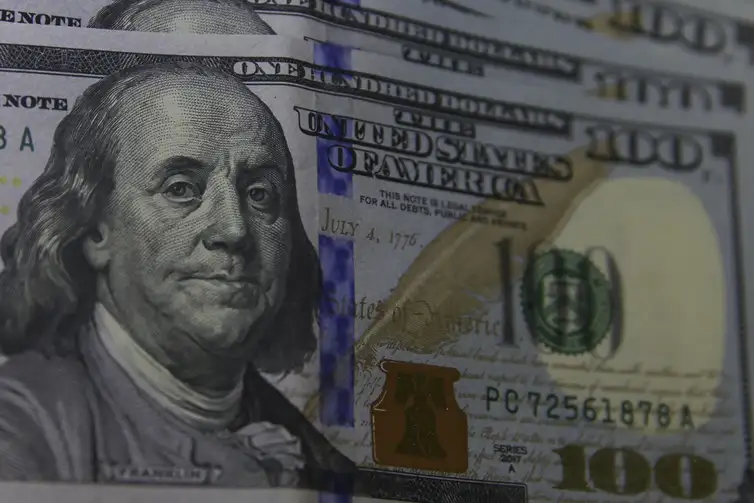
When the dollar broke the barrier of R$6.005 this Monday morning (23), the country did not just witness another spasm of Faria Lima's operating desks. It saw, translated into quotations, the exhaustion of a governance model that insists on managing structural problems with tactical fixes and convenient silences. In less than a month, the American currency went from R$4.99 on the eve of the second round to flirt with a historically traumatic level. Blaming the "market" exclusively for supposed political sabotage is as shallow as attributing the entire surge to a single decree from the Palácio do Planalto. The truth, more uncomfortable and more urgent, is that the exchange rate is paying the bill for a crisis of credibility shared between the Executive and Legislative branches.
Intellectual honesty is necessary when reconstructing the trigger for this movement. The initial shock, on October 26th — when the Ptax rate jumped 9.19% in a single trading session shortly after the re-election of Luiz Inácio Lula da Silva over Flávio Bolsonaro — reflected first and foremost the miscalculation of financial agents who had priced in the government's defeat. Add to this a hostile international environment, marked by stubbornly high American interest rates and fears about the fall in oil, a vital commodity for the Brazilian trade balance. However, a post-election shock usually dissipates within a few days when it finds solid fundamentals ahead. If the dollar continued to climb for four consecutive weeks, it is because the external fire found abundant fuel in Brasília.
The effects of this stubbornness have already escaped the financial terminals and have begun to suffocate the real economy. The Focus Bulletin released today by the Central Bank outlines a scenario that should keep any government official up at night: projected inflation exceeded the target ceiling for both 2026 (5.15%) and 2027 (5.12%); the Selic, already asphyxiating at 13.75%, had its projection for next year raised to 13%; and GDP growth for 2027 declined to a mediocre 1%, in the sixth consecutive negative review, while net debt rises above 70% of GDP. Not even the direct intervention of Gabriel Galípolo's Central Bank — which resorted to selling US$1 billion of international reserves on Thursday (19), after two insufficient line auctions the day before — managed to contain the bleeding. Once again, an elementary lesson of macroeconomics has been proven: no monetary authority supports the exchange rate alone when fiscal policy moves in the opposite direction.
It is precisely at this point that the so-called "Moretti Plan" — PLP 299/2026, which will be voted on in the Chamber today at 6 pm — fails to deliver what the moment demands. It is understandable, from a political point of view, that the government defends the preservation of the constitutional floors for Health and Education and the policy of increasing the minimum wage. The mistake is not in protecting social policies, but in trying to convince the country that a temporary relief package replaces a credible fiscal strategy. Of the up to R$56.1 billion estimated to try to reach a surplus of 0.5% of GDP in 2027, only a modest fraction comes from effective spending cuts. The bulk of the bill falls on restrictions on tax credits, increased burden on special regimes and the postponement of transfers of the Kandir Law to states and municipalities for the next decade — measures with a high risk of judicialization and temporary effect.
Worse than the shyness of adjustment are the contradictory signals embedded in it. While pulling the trigger on the spending limit from 2.5% to 2% only on a transitory basis and pushing the fight against civil servants' super salaries to an abstract period of 120 days, the same text makes an exception to remove up to R$10.5 billion in diesel subsidies from the calculation of the 2026 fiscal target. As if that were not enough, during passage through the Senate, the obligation to present transparent five-year projections for mandatory expenses was removed. By adding this vacillating design to President Lula's stance — who just on Saturday (21) reiterated that he was in no rush to announce who will lead the Ministry of Finance in the fourth term —, Planalto feeds exactly the vacuum that turns caution into panic. In nervous markets, uncertainty is never interpreted willingly; it is priced according to the worst case scenario.
It would be frivolous, however, to focus all the criticism on the Executive and spare the fiscal hypocrisy of the National Congress. In the same week that senators endorsed the adjustment of just over R$50 billion for 2027, sixteen parliamentary committees approved R$85.9 billion in requests for extra amendments for next year's Budget — a figure that piles on top of the R$44.8 billion in individual and bench amendments already mandatory. The Brazilian Parliament has developed a peculiar talent for preaching austerity over the microphones while sequestering increasing portions of the public budget without transparent criteria for economic or social return. There is no arithmetic capable of balancing the accounts of a State in which the Executive hesitates to cut back on meat and the Legislative acts as the majority partner in spending.
Getting out of this trap does not require blind submission to market dogmas, nor the dismantling of the social protection network, but rather an urgent dose of republican courage. The first step is to abandon the logic of annual emergency packages and build a structural, multi-annual review of mandatory expenses, immediately restoring the transparency of medium-term fiscal projections so that economic agents and citizens can see a stable horizon. Secondly, the State needs to have moral authority before asking for more taxes from the productive sector: the 120-day deadline for regulating super salaries needs to become an effective and binding cut, eliminating frills that mock the constitutional ceiling, at the same time that tax waivers start to be audited based on concrete results, and not due to lobbying.
In parallel, it is essential to end the culture of creative exceptions in the tax framework. If there is a real emergency that justifies subsidizing diesel or mitigating an external shock, the resource must come from explicit reallocation within the spending limit, never from off-target accounting maneuvers that destroy the credibility of the rule. This discipline must fully reach Congress: submitting all parliamentary amendments — mandatory or commission — to the same real growth ceiling as other expenses, with rigorous traceability and impact assessment, is no longer a technical agenda but has become a matter of budgetary survival. Finally, it is up to the President of the Republic to end the suspense over the economic team, appointing a clear command for the Treasury with a real political mandate to sustain the fiscal trajectory and return to the Central Bank conditions to lower interest rates without burning reserves.
The dollar at R$6 is not a financial abstraction reserved for stock market investors. It arrives disguised as the price of bread, fuel, medicine and unviable credit that makes small business owners shelve hiring plans. Political ambiguity may even buy a few months of peace in the corridor negotiations in Brasília, but it exacts a brutal interest from those who work and produce outside of it. Fiscal credibility is not an ideological concession to the right or betrayal to the left; It is the minimum condition for any government to be able to bring down interest rates, reactivate growth and deliver something better to the country than stagnation with high inflation.
References
- InfoMoney. Focus Bulletin raises projections for inflation and dollar and predicts Selic at 13% in 2027. 23 nov. 2026. Available at:InfoMoney.
- UOL Economics. Focus Bulletin: market raises projections for inflation, interest and dollar in 2027. 23 nov. 2026. Available at:UOL Economy.
- Look. Dollar threatens R$6 and puts Galípolo facing a new test at BC(23 Nov. 2026) andBC starts burning reserves to contain the dollar, which is close to R$6(Nov. 19, 2026). Available at:Veja – Test at BCandVeja – Reserve auction.
- JOTA. Senate approves basic text of fiscal package with expected impact of up to R$56 billion. 12 nov. 2026. Available at:JOTA.
- Power360. Chamber analyzes government fiscal adjustment package this Monday. 23 nov. 2026. Available at:Power360.
- CNN Brasil. Chamber begins analysis of fiscal adjustment today after resistance in the Senate. 23 nov. 2026. Available at:CNN Brazil.
- Brazil Agency. Fiscal package provides 120 days for Congress to discuss super salaries. 11 nov. 2026. Available at:Brazil Agency.
- Justice in Focus. Commissions propose R$85.9 billion in amendments to the 2027 Budget. 19 nov. 2026. Available at:Justice in Focus.
- Perseu Abramo Foundation / Focus Magazine. Senate approves government fiscal adjustment project and rejects changes. 19 nov. 2026. Available at:Perseu Abramo Foundation.
- Confidence Exchange. Impact of elections on the dollar: what happened in 2026?. 26 Oct. 2026. Available at:Confidence Exchange.
- TradeMap. Weekly TradeLetter | 25 – 31 October 2026. 30 Oct. 2026. Available at:TradeMap.
- Political Broadcasting. Dollar surpasses R$6 and retreats again as the market follows Lula's fiscal package. 23 nov. 2026. Available at:Political Broadcast.
Disclaimer: The opinions, analyses, and interpretations expressed in this article are the sole responsibility of its author(s) and do not necessarily reflect the editorial position of Hermenêutica Política.
Subscribe to our Newsletter
Fill in your details and choose the sections you want to receive.

Wagner Constâncio
Wagner Constâncio é bacharel em Direito pelo Centro Universitário de Belo Horizonte (UniBH), com especialização em Direito Público Administrativo e Direito do Consumidor. Atua como Analista Jurídico e também se dedica à produção de conteúdo sobre política nacional, com foco na legislação e na jurisprudência brasileira.


